What’s On/Finance
Six UAE tax invoice errors that delay payment
When a client's finance team sends an invoice back, the work is rarely the problem. A missing detail is, and each one pushes payment into the next cycle.

A rejected invoice seldom comes with a note. It simply goes unpaid, and weeks later someone discovers that the client's TRN was missing, the VAT appeared only in dollars, or the document said Proforma at the top. By then the payment run has gone, and the invoice waits for the next one.
The rules for a UAE tax invoice are not complicated, and most of the errors below are small. They are also the ones businesses repeat month after month. This is general information, not tax advice: check your own position with a registered tax agent, and the full rules with the Federal Tax Authority.
The basics in one paragraph
UAE VAT is 5%. Registration is mandatory once taxable supplies pass AED 375,000 in twelve months, and voluntary from AED 187,500. A registered business issues a tax invoice for each taxable supply, generally within 14 days of the date of supply. For a service, the date of supply is usually the earliest of when the service is completed, when payment is received or when the invoice is issued. On a monthly retainer, that normally makes each month a supply of its own.
The TRN that is missing or wrong
A full tax invoice must show your name, address and TRN, and the client's name and address, with their TRN if they are registered. The TRN is the 15-digit number the FTA issues on registration, and a client's finance team will usually check both.
The usual slips: the client's TRN left blank because whoever raised the invoice did not have it, a TRN copied from another client because last month's invoice served as the template, or a legal name that does not match the one on the client's registration. Hold each client's legal name and TRN in one place, confirmed once with their finance team, and have every invoice draw from it. The TRN verification service on the FTA's website confirms whether a number is valid and whose it is.
Numbers that repeat or skip
Each tax invoice needs a sequential number that identifies it and the order in which it was issued. Two colleagues invoicing from their own spreadsheets, a new template that restarts at 001, or a separate series for one large client will each break that sequence.
Run one sequence for tax invoices, issued from one place. The sequence is part of your records, so if a number is issued by mistake, note why instead of quietly reusing it for a different invoice.
VAT shown only in another currency
Invoicing international clients in US dollars is allowed. Leaving out the AED figure is not. The total VAT must be shown in AED, and where the invoice is in another currency, the VAT amount in AED and the exchange rate used must appear on it.
An invoice that shows USD 500 of VAT and nothing more looks complete to the person who sent it, and incomplete to the person who has to account for it.
A proforma doing an invoice's job
Sending a proforma to collect payment in advance is a sensible habit. Trouble starts when the proforma is the only document ever issued. Neither a proforma nor a quote is a tax invoice, and they are among the documents finance teams most often send back.
Billing in advance is fine. Issue the tax invoice in the period in which you want to account for the VAT, with the words "Tax Invoice" clearly displayed, and treat the proforma as what it is: a request for payment, not a record.
Changing an invoice after it has gone
A client negotiates the fee down, a deliverable is cancelled, or a line was simply wrong. The tempting shortcut is to open the original, amend it and send it again under the same number. That is the one thing not to do.
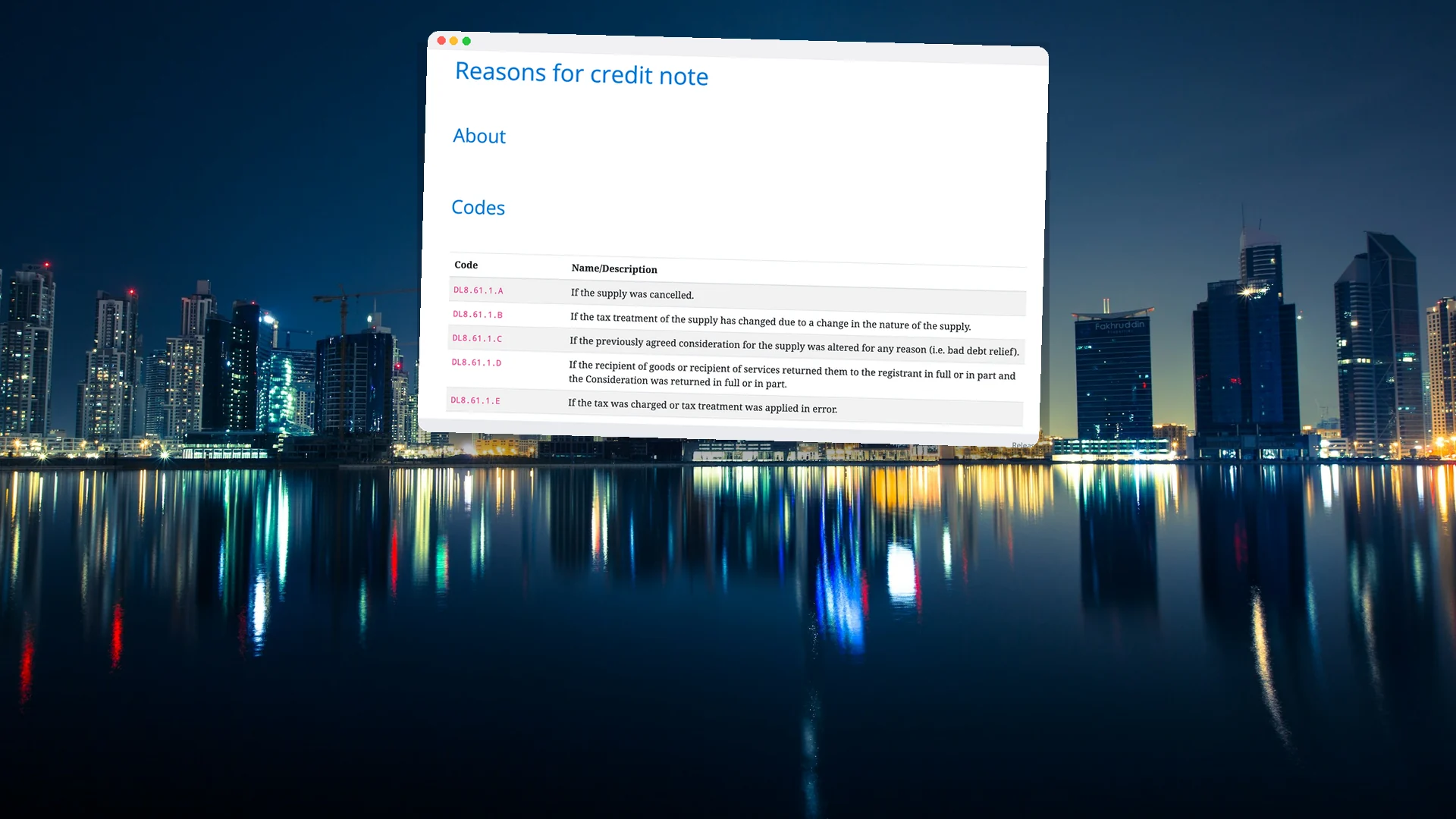
Once an invoice has been sent, it stays as it is. If the amount changes, issue a tax credit note that refers to the original invoice. It needs similar details to a tax invoice, including the value of the change and the VAT adjusted, and it keeps the records honest on both sides.
A sent invoice is a record, not a draft. The only way to change it is a second document that says what changed.
Zero-rating an overseas client by default
Some services supplied to a client outside the UAE can be zero-rated as exports: VAT is charged at 0%, but the supply still appears on your return. It is not automatic. Broadly, the client must not have a place of residence in the UAE and must be outside the UAE when the services are performed, and the services must not be connected with goods or property in the UAE or used by someone in the UAE.
Work for a foreign brand's UAE launch, delivered to a marketing team based in the UAE, may not qualify. If the zero rate turns out to be wrong, the VAT becomes yours to pay. Check the conditions, or take advice, before invoicing at 0%.
Smaller slips that still cost a cycle
- A single line reading "services" on a large invoice, which the client's finance team cannot match to a purchase order.
- No date of supply where it differs from the date of issue.
- A simplified tax invoice sent to a registered client for a supply above AED 10,000, where a full tax invoice is needed.
- No reverse charge statement where the client must account for the VAT themselves.
- A discount agreed in a meeting that never appears on the invoice.
Make the correct invoice the default
Almost all of these errors come from invoices assembled by hand, copied from earlier ones, by whoever has a spare hour at month end. The cure is structural: client details stored once, one numbering sequence, and a process that will not let a document go out without the fields a tax invoice needs. Credit notes should be raised against the original, and someone, or something, should flag a simplified invoice that goes over AED 10,000.
If invoicing in your business still depends on copying last month's file, it is a strong candidate for automation. Workflow automation is one of the things ALXO builds, and we would be happy to talk about what it could look like for your billing.