What’s On/Finance
The required fields on a UAE e-invoice, in plain English
A UAE electronic tax invoice has 51 mandatory fields, and a commercial one has 49. Most will look familiar. A handful are new, and those are the ones that cause rejected invoices.
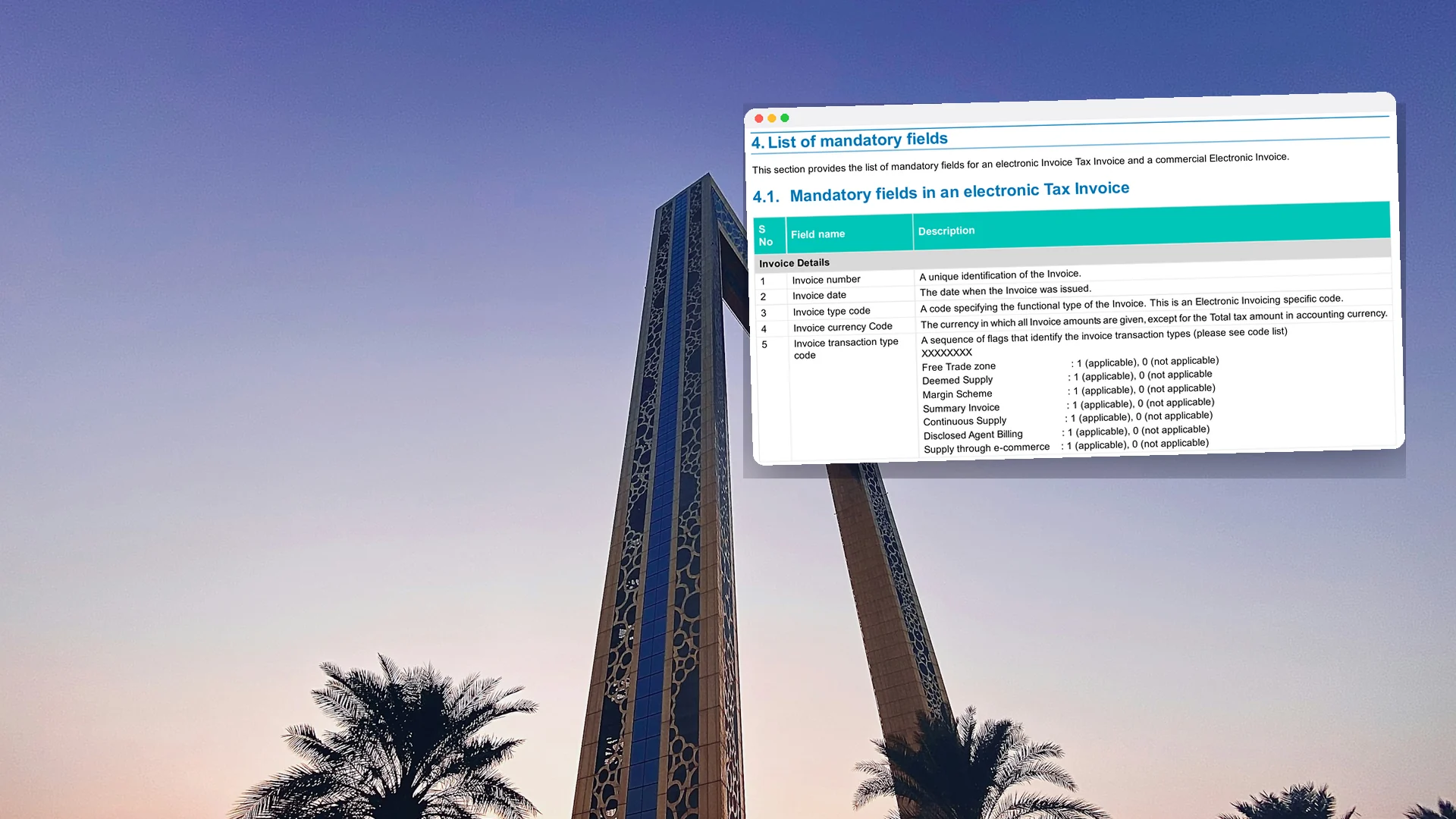
Think of an e-invoice as data rather than a document. It is an XML file built to a specification called PINT AE, and your accredited service provider checks it field by field before it goes anywhere. The Ministry of Finance published the list of required fields on 23 February 2026: 51 for an electronic tax invoice, and 49 for a commercial invoice from a business that is not registered for VAT. A few older FAQs still quote 50.
The familiar part
Article 59 of the VAT Executive Regulation already asks for the supplier's name, address and TRN, the customer's TRN if they are registered, a sequential invoice number, the date, a description of what was supplied, and for each line the unit price, quantity, tax rate and amount, with the tax in dirhams. All of it carries over.
The new part
- A Peppol address for each party, made of the scheme 0235 and a 10-digit Tax Identification Number. According to the Ministry, your TIN is the first 10 digits of your corporate tax TRN, including if you belong to a tax group.
- A legal registration number with its type: TL for a trade licence, EID for an Emirates ID, PAS for a passport or CD for a Cabinet Decision. A trade licence also needs the name of the authority that issued it, typed out in full, as no code list exists.
- Emirates as codes: AUH, DXB, SHJ, UAQ, FUJ, AJM or RAK. A written-out Dubai will not pass.
- A properly formed TRN: 15 digits, beginning with 1 and ending with 03.
- Eight yes-or-no transaction flags: free zone, deemed supply, margin scheme, summary invoice, continuous supply, disclosed agent billing, e-commerce and exports.
- A unit of measure for every line, such as hours, days or a lump sum, taken from the UN/ECE code lists.
- A VAT category for every line: standard rated, zero rated, exempt, out of scope, reverse charge or margin scheme.
- Line amounts in dirhams regardless of the invoice currency. Invoices in another currency also state the exchange rate and the total with VAT in AED.
- A payment means code, and an account number if the customer pays by bank transfer.
What goes away
- Simplified tax invoices, and FTA dispensations from invoice requirements, do not carry over to e-invoices.
- QR codes and digital signatures were never part of the UAE design. Each invoice gets a unique identifier from the provider instead.
Customers who are not on the system yet
If your customer has not joined e-invoicing, your provider addresses the invoice to the placeholder 0235:9900000098, and you also send them an ordinary invoice such as a PDF. For overseas customers without a Peppol ID, the placeholder is 0235:9900000099: they receive their copy outside the network, usually by email, and the invoice is still reported to the FTA.
Where invoices fail
- Typed labels where codes are expected, for emirates, units or VAT categories.
- Item types. The field is optional, but marking a line as a service makes a service accounting code compulsory.
- Incomplete customer records: a missing legal name, emirate or city, a vague country, or a TRN in the wrong format.
- Foreign-currency invoices that leave out the dirham total.
Most UAE businesses go live on 1 July 2027, and tidying customer records takes longer than people expect, so it is the sensible first job. If you want a second pair of eyes on your invoice set-up before then, talk to ALXO.