What’s On/Social
How LinkedIn's 2026 feed decides who sees your posts
In March 2026 LinkedIn rebuilt its feed around large language models, then turned on engagement pods and AI slop. For company pages and founders posting from the Gulf, here is what LinkedIn has confirmed, what it has not, and what to change.
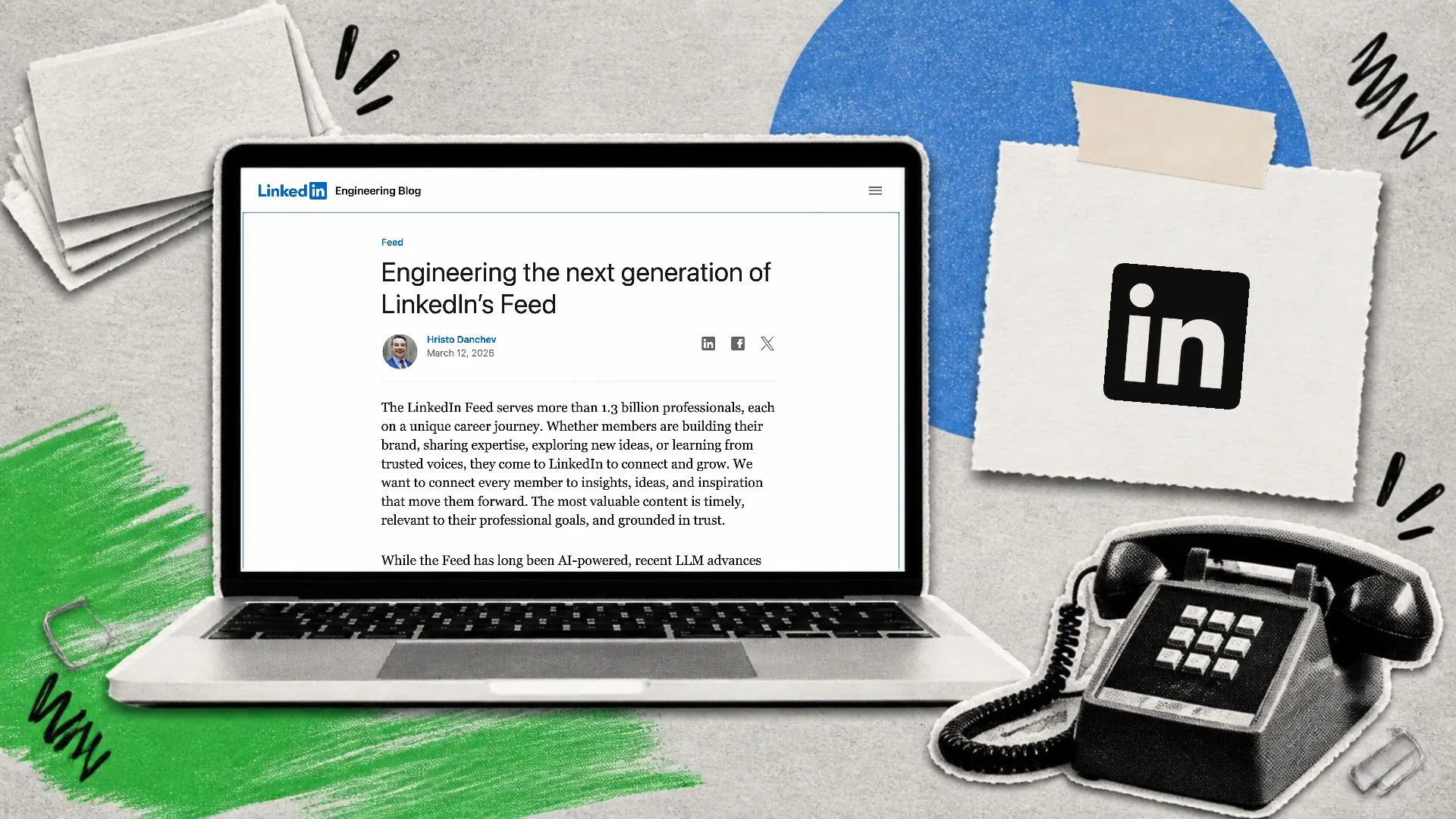
On 12 March 2026 LinkedIn explained, in unusual detail, how it had rebuilt the feed. The several separate systems that used to find candidate posts for each member were replaced by one, built on a large language model, and a new model now ranks what it finds. The same day, Tim Jurka, an engineering vice president at LinkedIn, listed what the feed would show less of. Since then LinkedIn has moved against engagement pods, automated comments and generic AI-written posts. If your company page or your founder's profile is part of your marketing, this is the biggest change to the platform in years.
Two steps: finding posts, then ranking them
- Retrieval. Candidate posts used to come from several sources: recent activity in a member's network, posts trending in their area and industry, and a number of recommendation systems. One system has replaced them. It uses a language model to describe posts and members in text, and matches them by meaning instead of by keyword. A post is described by its text, format and author, the author's headline, company and industry, and the engagement it has had. A member is described by their profile, skills, work history, education and the posts they have engaged with.
- Ranking. A model LinkedIn calls a Generative Recommender reads more than a thousand of a member's past interactions and predicts what they will do with a post: click, skip, stay on it for a long time, like, comment or share.
LinkedIn's own example is a member interested in electrical engineering being shown posts about small modular reactors. The subjects share no keywords, but they are related in meaning. New posts are processed almost in real time, and a post gaining engagement is updated as it goes, so a post about breaking news can reach people within minutes. LinkedIn also says it audits the models so that posts from different creators compete on equal terms.
What LinkedIn left out matters as much. It published no weighting for any signal, and the engineering post says nothing about links, hashtags, video, documents or how often to post. Format is one input among many.
Followers count for less
Jurka wrote that the feed now shows relevant posts whether they come from a member's network or from people they have never connected with. A post on a narrow subject can find the people who care about that subject, even when its author has few followers. It works the other way too: a large following does not guarantee reach for a post those followers do not care about. Since June 2026, creators' post analytics have split reach between people inside and outside their network, which makes the effect visible. LinkedIn has not said whether Company Pages will get the same split.
What the feed now holds back
- Engagement bait, such as asking readers to comment a single word if they agree.
- Text posts padded with an unrelated video purely to win extra distribution.
- Recycled thought leadership with nothing new in it.
- Engagement pods: coordinated groups, in LinkedIn's definition, whose members like, comment on and share each other's posts to inflate them. LinkedIn removes these groups, cuts the reach of posts boosted this way, and may restrict members who join them or drop them from programmes such as Top Voices.
- Comments generated by third-party software or browser extensions. LinkedIn does not permit them, and keeps them out of the most relevant comments.
- Generic AI writing, in posts or comments. LinkedIn said in May 2026 that content showing signs of AI slop is less likely to travel beyond the author's network, and that its detection proved right 94 per cent of the time in early testing. By September it reported a 40 per cent fall in views of content classified as AI slop, more than a million members using a new report option within its first two weeks, and hundreds of thousands of automated comment attempts blocked each day.
Links, hashtags, scheduling and frequency
- Links. A LinkedIn product director said in 2025 that a link does not deliberately reduce a post's reach, provided the post makes sense without the click. The research saying otherwise comes from third parties.
- Hashtags. According to LinkedIn's product leaders they play no part in distribution, and the hashtag feed is being phased out. An older LinkedIn best-practice page still advises three to five, so its own material is inconsistent.
- Scheduling. Publishing through a scheduling tool or the API does not affect reach, LinkedIn said in 2025.
- Frequency. Two to five posts a week was the suggestion from a LinkedIn product vice president, who added that members posting twice a week get up to five times more profile views.
- Dwell time. The time people spend on a post has been a ranking signal since 2020, and the new model predicts it. LinkedIn has published nothing saying it is now the main signal.
Claims you can stop repeating
- 'The first hour decides everything.' LinkedIn has never said so, and its engineering post describes posts being scored again and again as they circulate.
- 'A comment is worth so many likes.' There are no published weights.
- 'Carousels and documents get a boost.' LinkedIn has not stated a boost for any format.
- Precise-sounding numbers: a named March 2026 authenticity update, a 97 per cent detection rate, pods losing 45 per cent of their reach. The only figures LinkedIn has given are the 94 and 40 per cent above.
- '360Brew runs the feed.' According to Jurka, LinkedIn tested this large model, described in one of its research papers, decided it did not fit and shut the test down.
What to change on your page and your founder's profile
- Write about a subject rather than for your followers. Be specific, so the model can match the post to the people who care about it.
- Make every post complete in itself. If it carries a link, it should still be worth reading without the click.
- Put the author's real expertise into their headline and profile. The model reads both.
- Drop engagement bait, pods and comment automation, and turn down any agency or tool that offers them.
- Use AI to edit, not to write. LinkedIn's own AI writing tools now concentrate on proofreading.
- Where the analytics show it, track reach outside the network as well as total impressions.
If you want a LinkedIn presence for your brand or your leadership team that suits the way the feed now works, specific, useful and written by people rather than pods, we would be happy to talk it over with you at ALXO.