What’s On/Operations
Meta's Muse agent: getting your business ready for AI that buys
Muse is Meta's first AI agent built to act rather than answer: it books, fills in forms and pays. It has not reached the Gulf, which gives UAE and GCC businesses time to make sure an agent can actually buy from them.
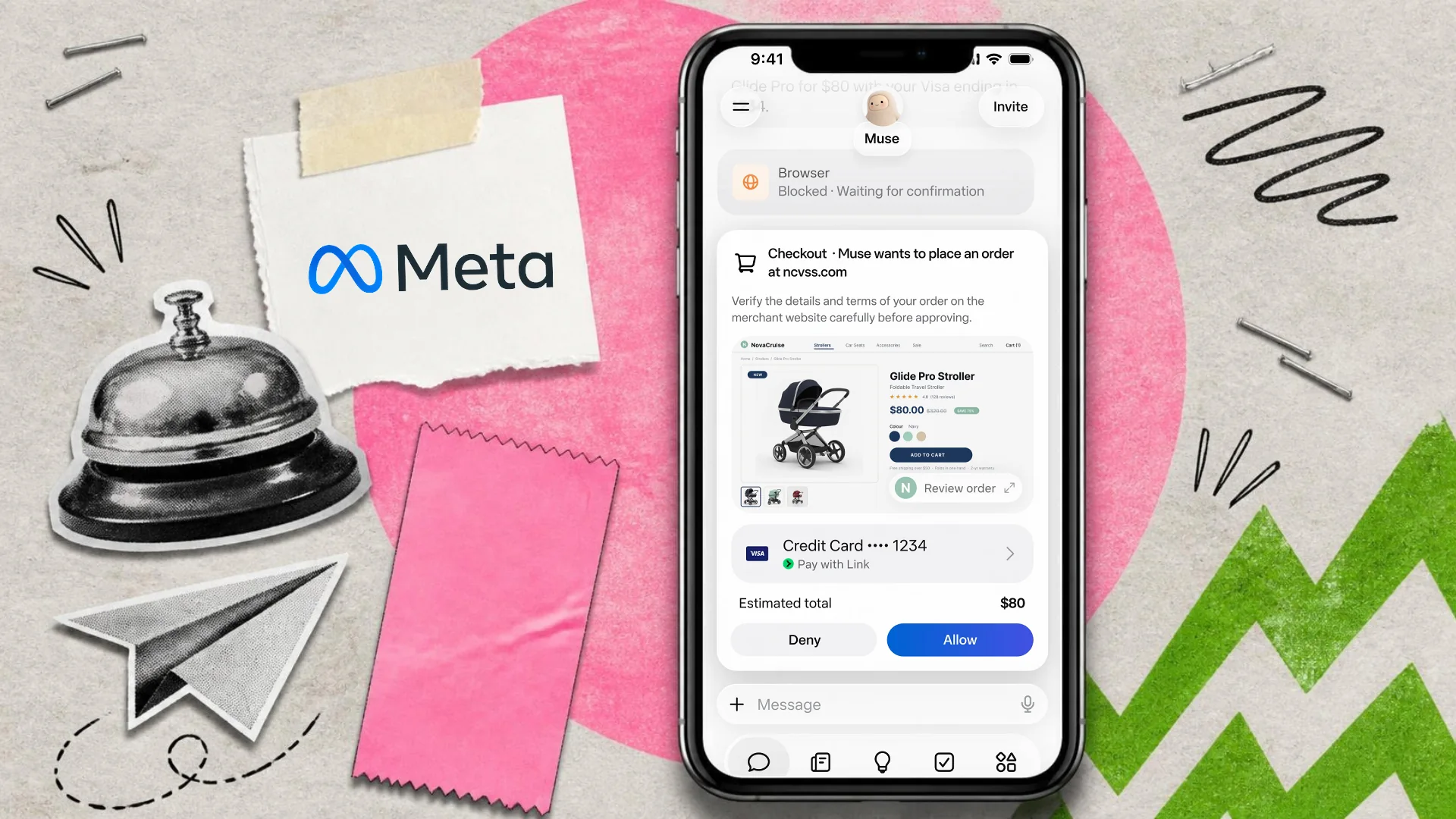
Most of what Meta has built with AI so far answers questions. Muse, launched on 8 September 2026, is designed to act. It is a personal AI agent that can write and send emails, make bookings, fill in forms and buy things, with payments handled through Stripe. It runs on Muse Spark, Meta's own model, and lives in its own app on iPhone and Android, at muse.ai and inside WhatsApp. Meta extended it at its Connect event on 23 September.
Muse is not available in the UAE or Saudi Arabia. For Gulf businesses, that is a reason to prepare calmly rather than to ignore it.
What Muse can do
- Carry out tasks across the web, from email and bookings to forms and purchases.
- Connect to shopping services and other tools. Meta added more of these connectors at Connect.
- Use its own Muse email address and, on a Mac, operate the computer. Both were announced at Connect.
- Also announced at Connect, for the coming months: a real-time avatar built on Meta's voice model, a small device called Muse Charm, and Muse on Meta's glasses.
Meta's privacy claims
Meta says Muse carries out tasks inside what it calls a Muse Secure VM, an isolated virtual machine, and that a Confidential VM, in which the user holds the encryption key, is due later in 2026. It also says Muse data is not used by its ad systems. These are Meta's own statements, but they are useful to have on file if your staff might one day use Muse with work accounts.
Availability and pricing
- It launched in the US for people aged 18 and over, and reached Canada on 18 September.
- TechCrunch reports a free tier, a Power plan at 20 dollars a month and a Maximum plan at 100 dollars a month. Meta's help centre gives Power 500 million Muse tokens a week and Maximum 3 billion.
- The UAE and Saudi Arabia are not included.
Early uptake, and early friction
Muse went to number one on the US App Store. Meta has not released download numbers. App analytics firms put it anywhere from about 900,000 downloads in six days to 2.8 million installs in twelve, depending on who measured and how, and TechCrunch reported that it was outpacing ChatGPT's early mobile launch. Market reports had Meta's share price up more than 11 percent on 21 September.
It has not all been smooth. Within two weeks of launch, Amazon blocked Muse from using its store. And Nat Friedman, head of product at Meta's AI lab, has acknowledged that Muse was heavily inspired by OpenClaw, an open-source agent.
Why it matters before it reaches the Gulf
An agent that books and buys changes who your business is really dealing with. Today a customer sees an ad, visits your website and decides. With an agent in between, the customer might just ask for a table on Thursday or a repeat of last month's order, and the agent reads the web and chooses what to suggest. Meta has not said how Muse picks between businesses, and says Muse data is not used by its ad systems. What you can control is what an agent finds when it arrives:
- A website that loads quickly, shows products and prices plainly, and does not bury the checkout under pop-ups.
- Bookings and orders that can be completed online, not only by phone or in a WhatsApp chat.
- Correct business details on Google, on maps and on review sites.
- A product catalogue with clear names, prices and stock.
None of this is new advice, but an agent is less forgiving than a person. A site a human can struggle through may simply defeat an agent, which will move on to a competitor. Gulf businesses that take most of their bookings and orders through WhatsApp conversations have the most to lose.
Four steps worth taking now
- Brief your team on what Muse is, and that it is not in the Gulf yet, before exaggerated versions reach them.
- Test your own booking and checkout as an impatient visitor would. Can a form be completed from start to finish? Are prices and availability actually on the page?
- Follow the Amazon block. Whether large retailers let agents in will shape how useful Muse becomes.
- Do not put business accounts on US-only services through workarounds.
Start with the pages where money changes hands: the booking form, the product pages and the checkout. If they are slow, check image sizes first.
ALXO designs and builds websites and booking flows, so if you would like yours looked at with AI agents in mind, get in touch and we can talk it through.